

International conference in Qatar ends with Doha Call to Action…
01 November 2024

30 October 2024
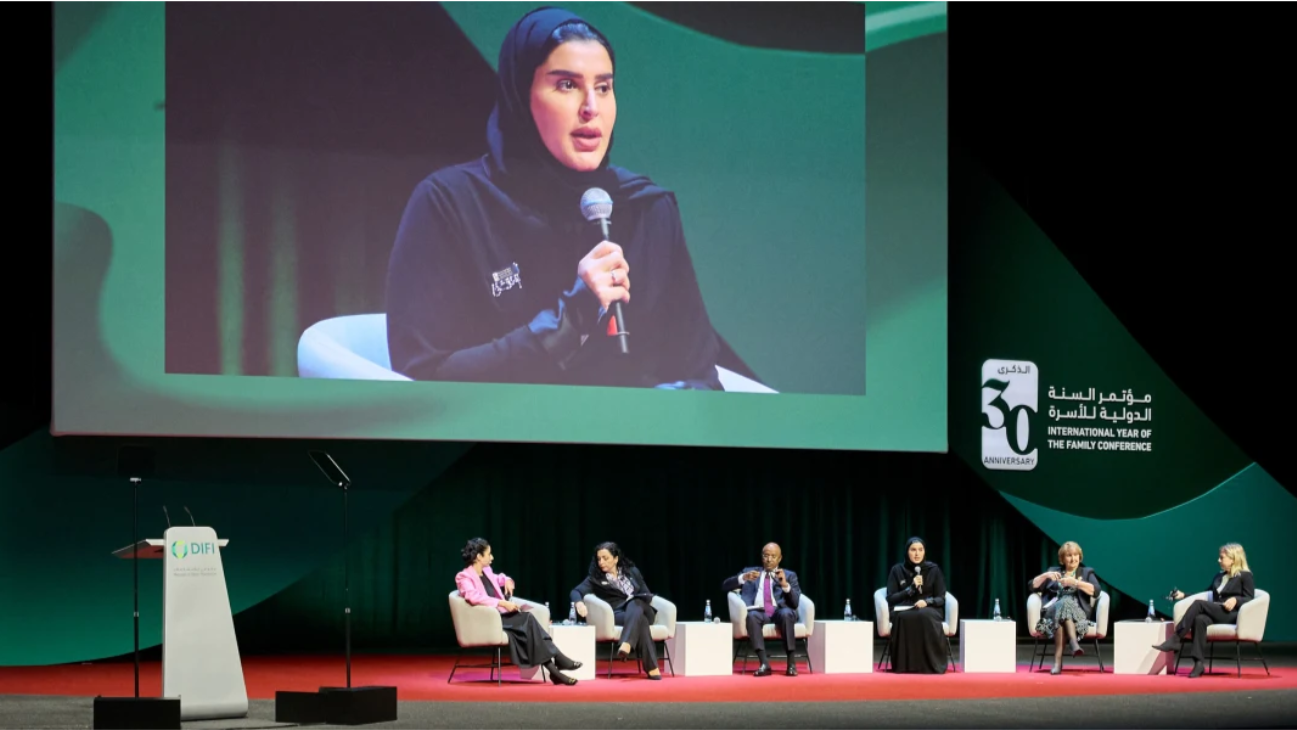
The inaugural high-level session, which was held today as part of the events of the 30th Anniversary of the International Year of the Family Conference, underscored the importance of focusing on policies that support families in light of the current challenges.
The inaugural session discussed the imperative of policies that support families by essentially focusing on families as the nucleus of society when economic and social strategies are crafted. The discussion addressed the current challenges facing the developing countries and ways to upward mobility for youth and keep them away from violence vortex.
HE President of the Republic of Kosovo Dr. Vjosa Osmani-Sadriu talked about the wars that engulfed Kosovo and subsequently impacted families and how the consecutive governments had succeeded in maintaining these families, pointing out that families in Kosovo are beset by existential problems and challenges of safeguarding their national identity.
Her Excellency stressed the importance of familial, social and economic policies with families as the nucleus of these polices in addressing pressing challenges and preserving childrens education, empowering vulnerable groups, and investing in youth to create a more resilient future. In this context, she emphasized the importance of optimal utilization and provision of technology, and facilitating access to it so as to empower new generations and achieve sustainable development for communities.
HE the President of the Republic of Kosovo emphasized that it is imperative to protect tight-knit families and morally supporting mothers and children and upward mobility for them to be protected from violence, affirming that these segments can be very productive in violence prevention.
There are many lessons that have been learned from familial issues and policies over the past ten years, as these issues represent a strategic concern for nations globally. Her Excellency elucidated the importance of raising awareness among families and young people to handle new technologies that should bring people together and protect values, said HE Dr. Vjosa Osmani-Sadriu.
HE President of Zanzibar Dr. Hussein Ali Mwinyi reviewed the experience of his country in giving foremost attention to families, adding that Zanzibar leveraged the technology to advance education until all new schools were provided with computers to access the internet. He pointed out that these strategies resulted in positive outcomes for students in all regions, particularly villages and remote areas, thus reducing unemployment and elevating the awareness level.
His Excellency highlighted that Zanzibar has invested in health system and facilities, critical infrastructure and human resources, as well as community awareness which have dramatically reduced mortalities among children and infants, in addition to providing economic opportunities and affordable loans to those in need so they can improve their lives. This was accomplished by offering a social network that included comprehensive health coverage, so that everyone could benefit from health services within the national health program for young people starting from the age of 17.
His Excellency indicated that his country offered a social service network, as well as legislation and laws that protect families and enhance the welfare of elderly and people with disabilities, and other vulnerable groups. He spoke about the community support system for children and women, where a unit was established for women within police stations to report any violence against themselves or against children and girls, stating that these strategies not only enhance the quality of life for families but also contribute to the growth and prosperity of society.
HE Dr. Hussein Ali Mwinyi affirmed that what has been accomplished thus far has given utmost priority to the social protection of families in the new plans, however, there is a lack of implementation strategies. He stated that his country has already implemented a plethora of strategies, but many people are still waiting for further plans, asserting that Zanzibar has set a strategy of best practices to enforce the plans during the next decade.
For her part, HE Minister of Social Development and Family Maryam bint Ali bin Nasser Al Misnad emphasized that the State of Qatar gives foremost priority to familial values and crafts policies accordingly, underlining that when Qatar set the Third National Development Strategy familial policies were the key pillar of this strategy, in addition to enacting numerous existing laws, such as the mandatory education law and family law, as well as many familial and social services.
Her Excellency cited the ethical family charter crafted last August, which encompasses numerous familial values that reflect those adopted by the State of Qatar, primarily honesty, cooperation, solidarity, dialogue, and mutual respect. She highlighted those previous civilizations succeeded in maintaining awareness of the value and importance of family by invoking a combination of values and laws, primarily familial values.
HE Al Misnad stated that the work now focuses on ensuring a tight-knot family in the community to be the bedrock of the community’s success in general, in addition to cementing the spirit of responsibility, underlining that shifting toward individualism may lead to a lack of focus on the common good of society and a shift towards individual interests. In this context, she stated, Therefore, we must take sincere and serious steps to understand the causes of these phenomena.
Her Excellency highlighted the importance of raising awareness about the roles of social units in Qatari society, such as the tribe, family, religion, and identity, noting that awareness of these various social units ensures that Qatari individuals possess a sound understanding of how to interact with them, emphasizing the need for constant review of the objectivity of legislation related to social issues to study its economic, educational, psychological, and social impacts and consequences, aiming to achieve the best legislation that can keep pace with and address challenges.
For her part, President of the World Family Organization Dr. Deisi Kusztra emphasized the importance of familial policies in light of the significant changes and pressing challenges facing families across all regions of the world, pointing out that the decline of traditional systems, economic instability, and the dispersal caused by migration, displacement, and refuge, along with major technological developments and climate change, beget problems and challenges that prompt the international community and local governments to support policies and develop strategies that make families connected, as they are the first line of defense for their member, notably youth, girls, and children.
For her part, Director of the Center for Child and Family Policy at Duke University in the United States, Prof. Jennifer E. Lansford, explained that a UN report revealed a very high percentage of children worldwide facing environmental risks, noting that many problems have not arisen from children’s exposure to the internet and use of technology, adding that there are many positive aspects of technology when it is approached positively and in a way that benefits children and society as a whole.
In terms of urban migration, she highlighted the many problems that drive people to migrate to cities, including the availability of educational and job opportunities, among other factors, not to mention displacement due to natural disasters or armed conflicts.
Regarding how parents can support children in facing the challenges posed by technology, Dr. Deisi Kusztra said that from a policy perspective concerning the protection of children from the internet, parents should set limits on the time their children spend on screens and engage in dialogue about what they are watching.
She noted that parents also spend significant time on screens, emphasizing the need for discussions between parents and their children. Parents should put down their phones and give children more time to talk and interact with one another. This calls for raising family awareness about the risks associated with artificial intelligence and rapid developments in the world, and their impact on values, ethics, and community culture.
01 November 2024
31 October 2024
30 October 2024
30 October 2024
29 October 2024
29 October 2024
01 July 2024
10 March 2024
18 February 2024
13 December 2023
01 September 2023
23 April 2020